Neuroscience Research Guide
Co-Regulation With Horses: What the Science Says and What the Paddock Reveals
By Melissa Jean Jarzynski, MSPT, HPCS
Physical Therapist · Hippotherapy Clinical Specialist · Board-Certified HPCS
Co-regulation with horses is not a metaphor. It is a measurable physiological event — one that has been documented in peer-reviewed research and that has a clear neurobiological explanation. Understanding what co-regulation actually means, and why horses are unusually effective at facilitating it, requires looking at both the science of the autonomic nervous system and the specific characteristics of the horse as a species.
This page draws on the research behind Mechanism 04 of the full guide at The Paddock as Laboratory, expanding and deepening the science of equine co-regulation for clinicians, practitioners, and anyone who wants to understand what is actually happening in the paddock.
What Co-Regulation With Horses Means Neurobiologically
Co-regulation refers to the process by which one nervous system influences the regulatory state of another. It is a foundational concept in developmental neuroscience and attachment theory — the idea that nervous systems do not regulate in isolation, but are shaped by their relational environment.
The neurobiological basis for this is well established. The autonomic nervous system — which governs heart rate, respiration, digestion, and the stress response — is not a closed system. It is continuously influenced by social and environmental cues. Stephen Porges's Polyvagal Theory describes how the ventral vagal complex, the most evolutionarily recent branch of the vagus nerve, mediates social engagement and co-regulation. When we are in the presence of a calm, regulated other — whether human or animal — our own nervous system receives signals of safety that shift it toward parasympathetic regulation.
This is not a passive process. It involves bidirectional physiological communication — through facial expression, vocal tone, posture, breath, and heart rate — that occurs largely below the level of conscious awareness. The body reads the body of the other, and responds accordingly.
"Safety may not always be visible, but sometimes its traces appear in the rhythms two bodies begin to share."
The Horse as Co-regulator
Why Horses Are Uniquely Effective Co-Regulation Partners
Not all animals facilitate co-regulation in the same way. Horses have several characteristics that make them unusually effective as co-regulation partners — characteristics that are directly related to their evolutionary history as prey animals.
As prey animals, horses have developed an extraordinarily sensitive nervous system. Their survival has always depended on detecting subtle changes in their environment — shifts in tension, breath, posture, and movement — and responding quickly. This sensitivity does not disappear in domesticated horses. It means that a horse in a paddock is continuously reading the physiological state of the humans around it, and responding to what it detects.
This creates an unusual dynamic. The horse does not respond to what a person says or intends. It responds to what their body is actually doing — their heart rate, their muscle tension, the rhythm of their breath. In this sense, the horse functions as a kind of biological mirror, reflecting back the person's actual physiological state rather than the state they are presenting.
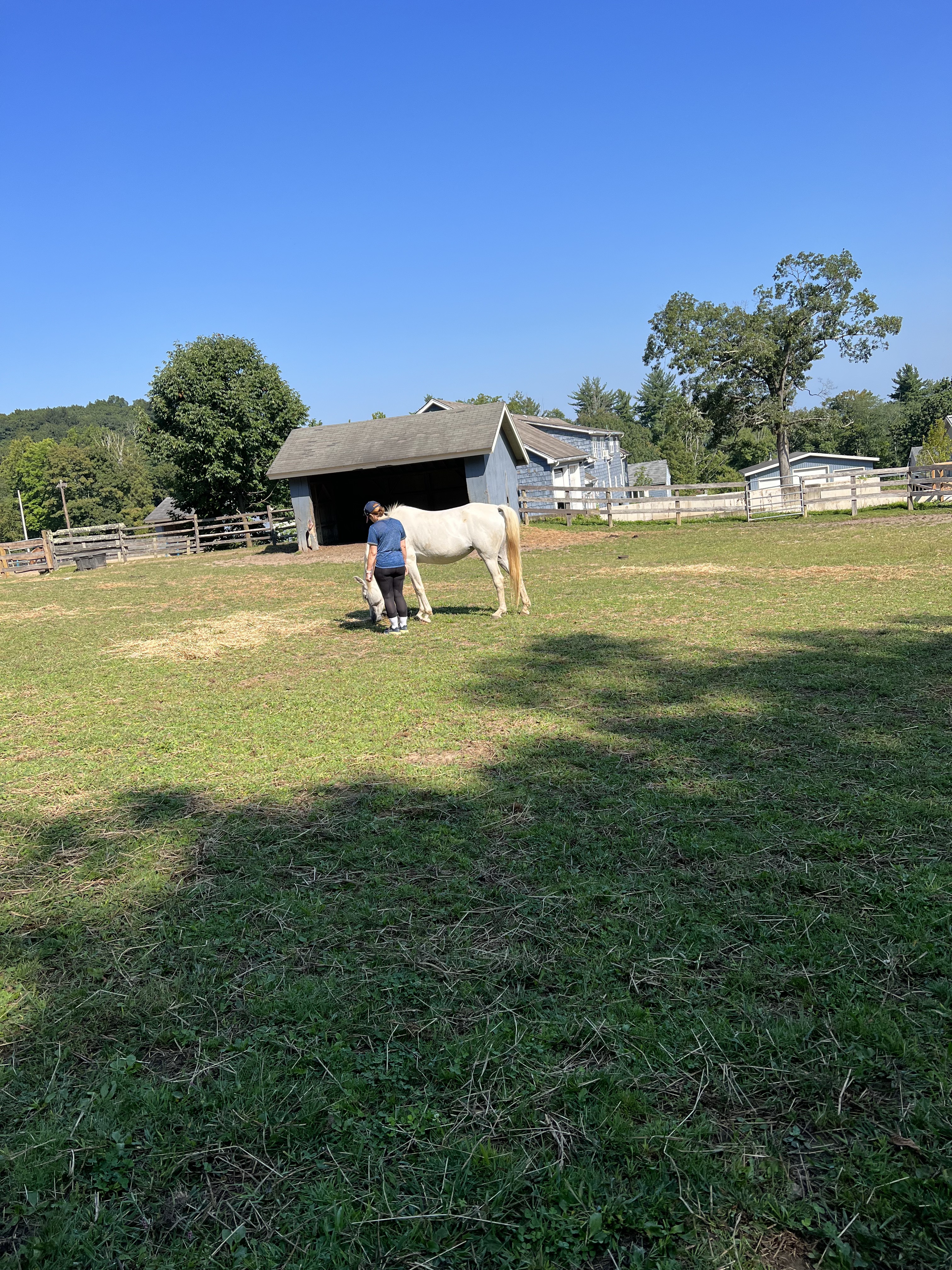
When the horse is calm and regulated, its own physiological state — its slow, rhythmic heart rate, its relaxed muscle tone, its steady breath — becomes available to the human nervous system as a co-regulatory signal. The human body reads these signals and, given sufficient safety and familiarity, begins to mirror them.
What the Published Research Shows on Co-Regulation With Horses
The research on co-regulation with horses has grown substantially in recent years, moving from anecdotal observation toward measurable physiological documentation.
A 2025 study published in Scientific Reports by Helmer, Hacohen, and Bart confirmed that mutual heart rate synchronization occurs between horses and riders — including children with ADHD. This is a direct physiological demonstration of co-regulation: the heart rate of the horse and the heart rate of the rider begin to move together, suggesting that the two nervous systems are influencing each other in real time.
A 2019 review in Animals by Scopa and colleagues examined the emotional transfer between horses and humans in equine-assisted interventions. The review proposed that the horse–human dyad functions as a single coupling system — meaning that the emotional and physiological states of horse and human are not independent but mutually influential. The review found that the more familiar the horse and human were with each other, the deeper and more consistent this coupling became.
These findings are consistent with what polyvagal theory would predict: that a calm, regulated nervous system in close proximity to a dysregulated one will exert a co-regulatory influence — and that this influence is stronger when the relationship involves familiarity, trust, and repeated positive interaction.
HRV Synchronization
As the interaction deepens, the two HRV patterns begin to converge — a measurable physiological marker of co-regulation occurring in real time.
Citations
[9]Helmer, A., Hacohen, A., & Bart, O. (2025). Scientific Reports, 15, 45312.
[10]Scopa, C., et al. (2019). Animals, 9(12), 1030.
[P]Porges, S. W. (2011). The Polyvagal Theory: Neurophysiological Foundations of Emotions, Attachment, Communication, and Self-Regulation. W. W. Norton & Company.
What This Means for Equine-Assisted Practice
For clinicians and practitioners working in equine-assisted therapy, hippotherapy, or ground-based equine programs, the research on co-regulation with horses has several practical implications.
First, the horse's own regulatory state matters. A horse that is anxious, overstimulated, or in a state of sympathetic activation is not in a position to offer co-regulatory support. The quality of the horse's nervous system — its capacity for calm, its tolerance for novelty, its ability to return to regulation after arousal — is a clinical variable, not just a welfare consideration.
Second, the relationship between horse and client matters. The research suggests that co-regulation deepens with familiarity and repeated positive interaction. This has implications for program design — the value of consistent horse-client pairings, the importance of allowing time for relationship to develop before expecting therapeutic outcomes.
Third, co-regulation with horses does not require riding. Ground-based interaction — grooming, leading, simply being in proximity to a calm horse — can facilitate the same physiological shifts. This is clinically significant for populations for whom riding is not appropriate or accessible.
About the Author
Melissa Jean Jarzynski, MSPT, HPCS is a trauma-informed physical therapist and board-certified Hippotherapy Clinical Specialist with more than two decades of clinical experience. She is a co-founder of the Stable Friendships Foundation and the creator of the Finding Peace in the Paddock™ curriculum. Her work sits at the intersection of physical therapy, equine behavior, and nervous system science.
Continue Reading
For a deeper exploration of all four mechanisms behind horse–human nervous system interaction, read the full guide: The Paddock as Laboratory — A Neuroscience Research Guide to Horse–Human Connection.
For the physiological basis of a nervous system reset with horses specifically, see: Nervous System Reset With Horses: The Neuroscience Behind What You Feel in the Paddock.