Neuroscience Research Guide
Nervous System Regulation and Reset With Horses: The Neuroscience Behind What You Feel in the Paddock
By Melissa Jean Jarzynski, MSPT, HPCS
Physical Therapist · Hippotherapy Clinical Specialist · Board-Certified HPCS
Most people who spend time around horses describe something they can feel before they can explain it — a quieting, a slowing down, a sense that the noise inside them has settled. Nervous system regulation with horses is the broader biological process behind that experience. The phrase nervous system reset with horses describes the acute moment within it — the measurable shift that occurs when a dysregulated nervous system begins to return toward balance. But what does either phrase actually mean physiologically? And what does the published research tell us about why it happens?
This page draws on the peer-reviewed science behind two of the four mechanisms explored in the full guide at The Paddock as Laboratory — rhythmic entrainment and physiological co-regulation — to explain what nervous system regulation and reset with horses means at the level of biology, not metaphor.
Nervous System Regulation With Horses: What Is Actually Happening
The term "reset" is not a clinical term, but it points toward something real: a measurable return toward parasympathetic regulation after a period of sympathetic activation. In practical terms, this means a reduction in heart rate, an increase in heart rate variability (HRV), a decrease in cortisol production, and a shift in brainwave activity from the fast, stress-associated beta frequencies toward the slower, calmer alpha range.
These are not vague or subjective changes. They are measurable physiological events — the kind that can be tracked with HRV monitors, cortisol assays, and EEG equipment. What makes horses unusual as a context for this kind of regulation is that they appear to facilitate it through multiple simultaneous pathways, rather than a single mechanism.
"This process is what many practitioners describe as a nervous system reset — a measurable return toward regulation driven not by effort, but by proximity to a calm, attuned animal."
Mechanism 01
Rhythmic Entrainment and the Parasympathetic Shift.
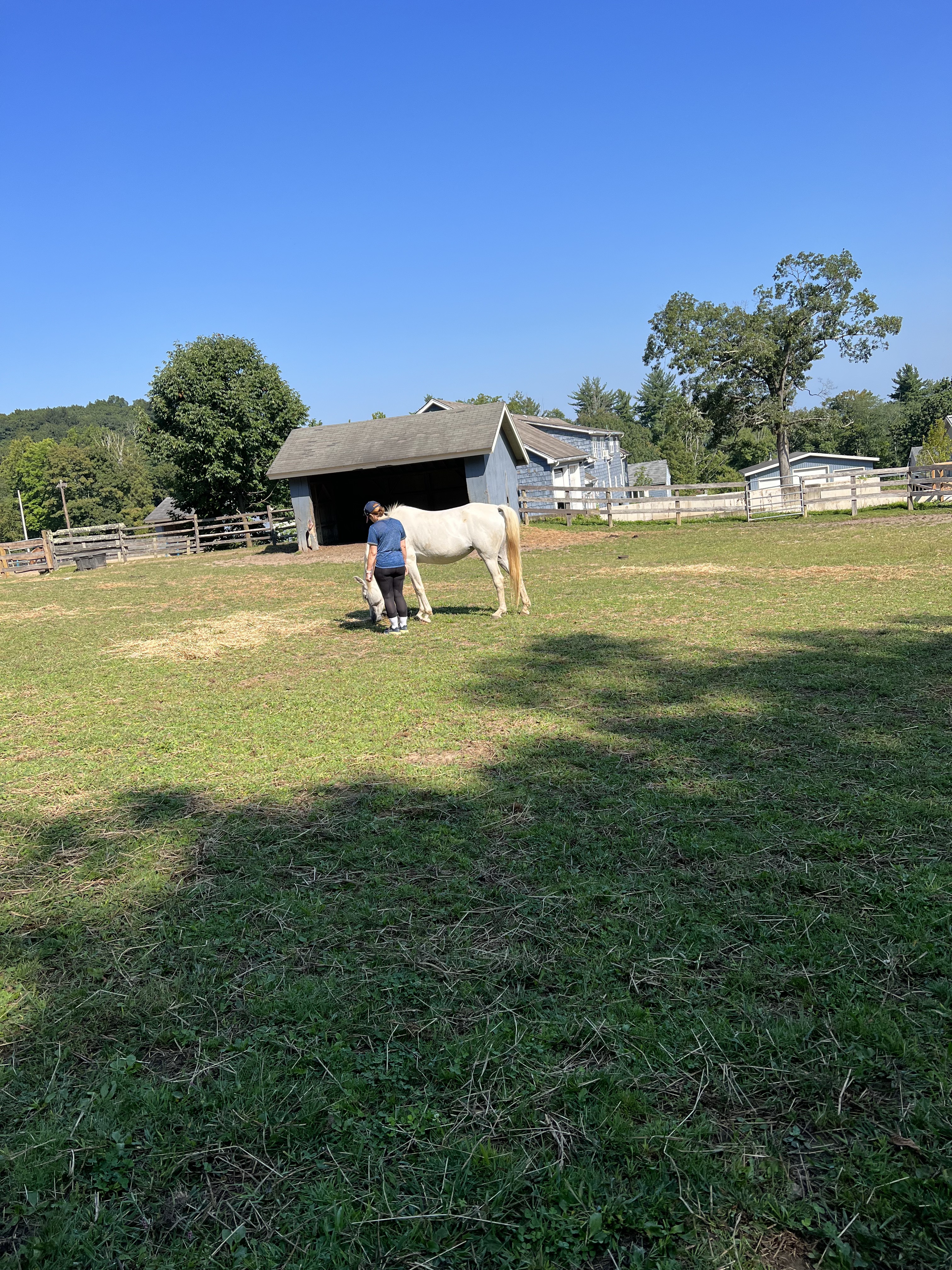
The human nervous system has a natural tendency to synchronize with external rhythms — a process known as neural entrainment. The horse's gait provides a powerful, consistent, and rhythmic sensory input that the body cannot easily ignore.
A 2024 study in the Annals of the New York Academy of Sciences analyzed the specific rhythmic properties of horse gaits and found that they contain the same simple integer-ratio patterns found in all human music across every culture on earth. The horse's walk provides a three-dimensional movement to the rider's pelvis that is almost identical to the movement of the human pelvis during walking — so potent that it is the foundation of hippotherapy.
This rhythmic, predictable movement acts as an organizing force on the human nervous system. It provides a constant, calming sensory input that entrains brainwaves, encouraging a shift from the fast, stress-related beta waves toward the slower, calmer alpha waves associated with relaxed, meditative states — a key component of what many describe as a nervous system reset with horses.
Citations
[4]Laffi, G., et al. (2024). Annals of the New York Academy of Sciences, 1543(1), 86–93.
[5]Sterba, J. A. (2007). Developmental Medicine & Child Neurology, 49(1), 68–73.
[6]Lagopoulos, J., et al. (2009). Journal of Alternative and Complementary Medicine, 15(11), 1187–1192.
Mechanism 02
Physiological Co-regulation: The Horse as a Biofeedback Partner
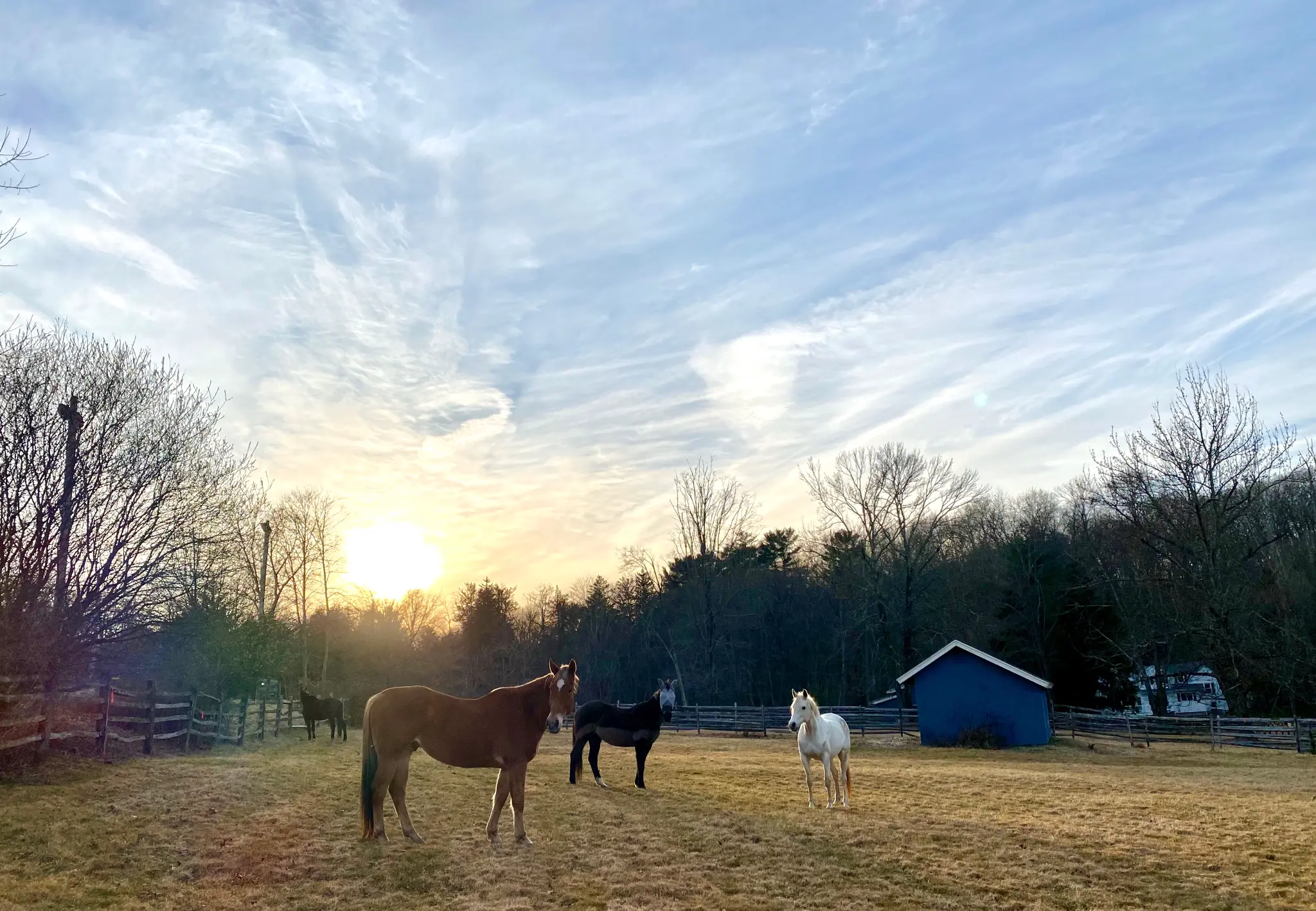
Perhaps the most direct mechanism behind a nervous system reset with horses is measurable physiological synchronization. A 2025 study in Scientific Reports confirmed that mutual heart rate synchronization occurs between horses and riders — including children with ADHD — suggesting a direct mechanism for emotional regulation.
When you are in partnership with a calm, regulated horse, your own autonomic nervous system begins to mirror that state. Your heart rate variability (HRV) synchronizes with the horse's, your breathing may regulate to its rhythm, and your production of stress hormones like cortisol decreases. The horse acts as a powerful, living biofeedback partner — actively co-regulating your nervous system.
A 2019 review in Animals further proposed that this emotional transfer is a key mechanism in the success of equine-assisted interventions, describing the horse–human dyad as a single coupling system. The more familiar you are with the animal, the deeper the synchronization goes.
Citations
[9]Helmer, A., Hacohen, A., & Bart, O. (2025). Scientific Reports, 15, 45312.
[10]Scopa, C., et al. (2019). Animals, 9(12), 1030.
The Nervous System Reset: What Regulation Looks Like in the Paddock
From a clinical perspective, the phrase "nervous system reset" describes a return toward homeostatic balance — a state in which the autonomic nervous system is no longer dominated by sympathetic activation (the fight-or-flight response) but has shifted toward parasympathetic regulation (the rest-and-digest response). Polyvagal Theory, developed by Stephen Porges, gives us a framework for understanding this shift: the nervous system is constantly scanning the environment for signals of safety or threat, and the horse's calm, regulated presence appears to register as a safety signal that supports downregulation.
The physiological markers of this shift include increased HRV, reduced cortisol, slower respiratory rate, and a reduction in muscle tone associated with defensive posturing. These are not outcomes that require a person to consciously relax or try to calm down. They appear to emerge from the sensory and relational environment that horses create — through their rhythmic movement, their physiological attunement, and their consistent, non-judgmental presence.
This is why the paddock is a particularly useful environment for trauma recovery. People navigating the aftermath of difficult experience often find that the body remains in a state of alert long after the mind has moved on. Equine-assisted therapy offers a context in which nervous system regulation can happen through relationship and sensory experience rather than through cognitive effort alone. The horse does not respond to what a person says. It responds to what their body is doing — and in doing so, it reflects back a kind of biological honesty that is rare in human interaction.
About the Author
Melissa Jean Jarzynski, MSPT, HPCS is a trauma-informed physical therapist and board-certified Hippotherapy Clinical Specialist with more than two decades of clinical experience. She is a co-founder of the Stable Friendships Foundation and the creator of the Finding Peace in the Paddock™ curriculum. Her work sits at the intersection of physical therapy, equine behavior, and nervous system science.
Continue Reading
For a deeper exploration of the four mechanisms behind horse–human nervous system interaction, read the full guide: The Paddock as Laboratory — A Neuroscience Research Guide to Horse–Human Connection.
To understand the neurobiological basis of co-regulation with horses specifically, see: Co-Regulation With Horses: What the Science Says and What the Paddock Reveals.